
Brunswick, OH · Garage Door Service
Spring Repair for Hudson's Early-1980s Garage Doors
Hudson's garage doors mostly date to the early 1980s build boom. Torsion spring failure looks different here than in older suburbs. We drive out from Brunswick for the job.
- Repairs & new doors
- Springs & openers
- Serving 4 nearby communities
How to Book
Hudson sits about 20 miles from our Brunswick shop, which means we schedule the trip rather than swing by on a whim between closer jobs. Call ahead and tell us the door size, whether it's one spring or two, and whether the door is stuck shut or stuck open - that tells us which springs and which end bearing plates to load before we leave. We don't keep a branch or a truck staged in Hudson, so same-day isn't something we promise here the way we might closer to home. What we can do is give you a real window once we know what's wrong, and show up with the right parts the first time instead of guessing twice. If the door won't move at all, stay away from the emergency release cord until a spring is actually confirmed broken - plenty of calls turn out to be an opener problem instead.
See the Hudson garage door page for the rest of what we cover out here, or check spring repair details for Brunswick itself if you're closer to the shop.
Why This Fails Locally
Hudson's housing stock skews newer than a lot of the towns we cover - median build year here runs around 1982, a good decade and a half past the 1968 median for the wider service area. That matters because doors from this era are almost always steel sectional panels on torsion springs mounted on a center bearing plate above the door, not the older extension-spring-over-the-track setups you still find in 1950s and 1960s stock nearby. The failure mode is more predictable: the torsion spring just fatigues out after enough door cycles, usually with a bang you hear from inside the house, and the door drops and won't lift under opener power alone.
With household income here running well above the regional median, we also see more double-wide, heavier insulated steel doors than the single-car doors common in older, denser suburbs - and a heavier door means the spring doing more work and giving out sooner relative to its rated cycle count. It's a newer-build fault, not an old-house fault, and the fix looks different because of it.
What Is on the Truck
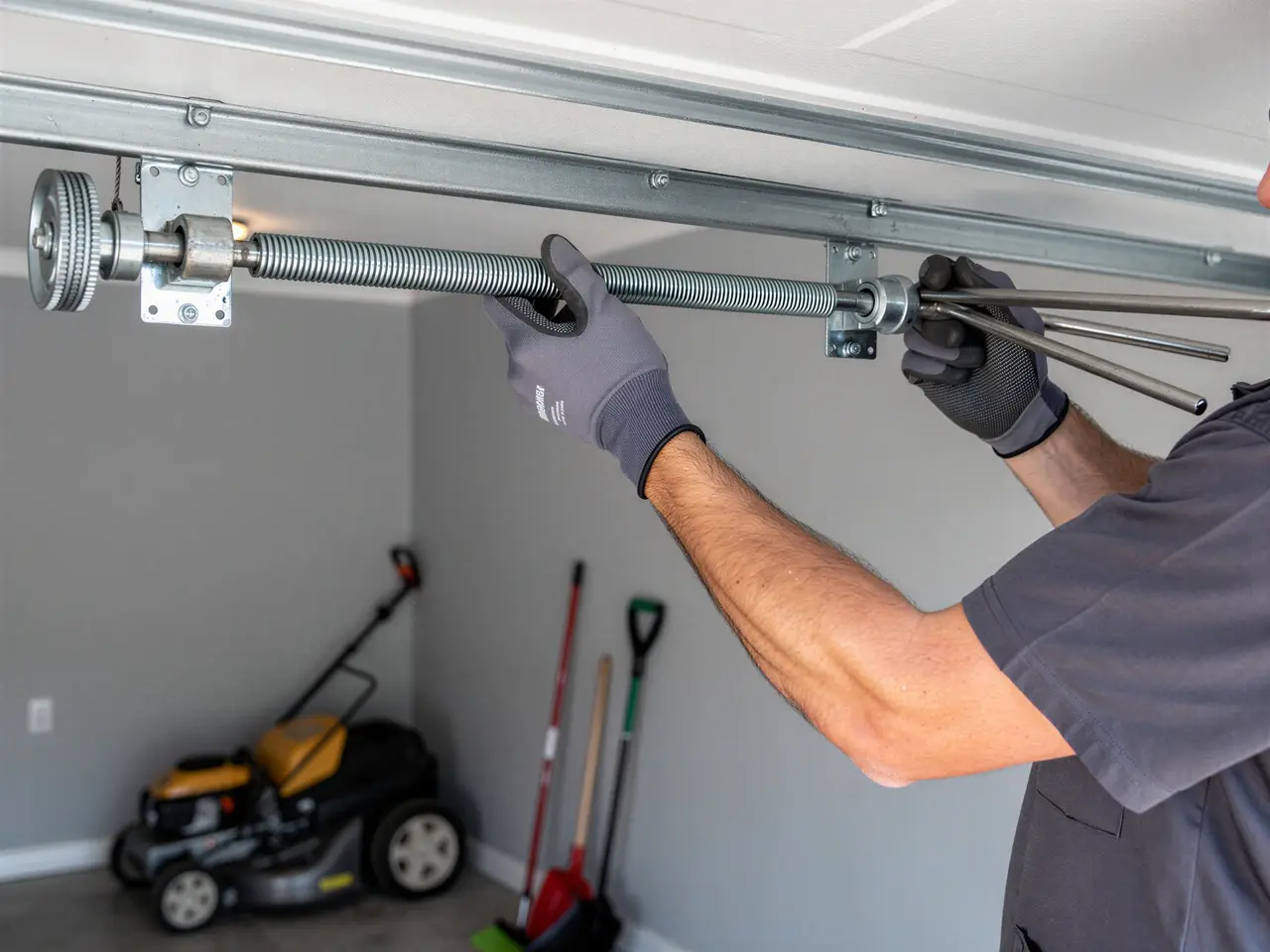
For a 1980s-era torsion setup we carry standard torsion springs sized to the common double-door and single-door torsion bar diameters, new center and end bearings, and winding bars - the originals on a 40-year-old door are often rusted or undersized for a safe re-wind even if they haven't snapped yet. We don't stock every obscure spring wire gauge ever made; if a prior owner swapped in a nonstandard spring or the door's been resized at some point, that can mean a return trip while we source the exact match. That's the honest limit of what fits on a service truck headed 20 miles out.
We also bring a torque wrench and a cycle-count reference so the new spring is matched to the door's actual weight, not just whatever was on it before. A spring sized for a 16-foot double won't hold up long if it's installed on a heavier insulated door, and with households in this income bracket more likely to have gone with a heavier insulated steel door, getting that sizing right the first time matters more than it does on an older single-car garage.
Time on the Job
A straightforward torsion spring swap on a standard double-door setup from this era usually goes quick once we're on site - it's a known hardware pattern, not a custom or deteriorated 1960s installation needing extra diagnosis. The time that adds up is the drive: 20 miles each way from Brunswick means the appointment window has to account for travel on both ends, not just wrench time at the house.
What we won't do is rush a bearing plate inspection just to hit a shorter window. If the center bearing is worn along with the spring - common once a door's original hardware has run a few decades - replacing just the spring and leaving a bad bearing in place means a comeback call sooner than it should be. We'd rather tell you that up front and do both while the truck's already there than have you pay for a second trip from 20 miles out.
Frequently asked questions
Why does a Hudson garage door spring break differently than one in an older suburb?
Hudson's housing stock mostly dates to the early 1980s, so most doors here are steel sectional with torsion springs on a center bearing plate, not the older extension-spring setups common in 1950s-60s housing nearby. The failure is usually straight fatigue from cycle count rather than a worn-out, decades-old hardware configuration.
Do you keep a truck stationed in Hudson?
No. We work out of Brunswick, about 20 miles from Hudson, and route a truck out for scheduled jobs rather than keeping equipment staged locally. That means we plan the appointment window around the drive, and we ask for door details up front so we load the right spring size before leaving.
Can you match the exact spring on an older or modified door?
Usually, yes, for standard torsion springs sized to common door weights and bar diameters. If a previous repair used a nonstandard spring or the door's been resized, we may need to source that exact match rather than carry it on the truck, which can mean a short return trip.
Book garage door service in Brunswick
Call now or request a quote - tell us what the door is doing and where you are.