
Brunswick, OH · Garage Door Service
Garage Doors on Brunswick's Pre-Insulation Housing Stock
Brunswick homes mostly date to the 1960s and 70s, built before insulation codes existed. Here's what that means for your garage door in a severe-cold climate.
- Repairs & new doors
- Springs & openers
- Serving 4 nearby communities
The Situation
Most of Brunswick went up between 1938 and 2002, with the median house dating to 1968, and the bulk of that stock clustered in the 1960s and 70s building boom that filled out this part of Ohio. That matters for garage doors because insulation requirements for residential garage doors didn't exist when these houses were framed. A lot of original doors on these properties are single-layer steel or wood panel with no foam core at all - just a sheet of material between the garage and whatever Ohio is doing outside that week.
If your house is one of the ones from that era and the door has never been replaced, you're likely looking at a door that was never designed to hold heat, resist condensation, or handle the swings this climate puts it through. It's not a defect. It's just what building standards looked like in 1968. The fix isn't always full replacement - sometimes a retrofit insulation kit on an otherwise sound steel door gets you most of the benefit for less money than a new unit. We'll tell you straight which one your door is.
What It Costs
We don't have a flat number to hand you here, because what a job costs depends heavily on what's actually on the house - and in Brunswick that varies more than people expect given how uniform the build years look on paper. A 1960s single-layer steel door retrofit is a different job than swapping out a warped original wood-panel door for an insulated steel replacement.
What we can tell you: median household income in this area runs around $85,435, and most homeowners here treat the garage door as a maintenance item, not a luxury upgrade - they fix what's wrong rather than replace the whole door unless the panel's bent or the insulation's failed completely. Where costs climb is when the original door is an odd size that was common in 1968 construction but isn't a stocked size now. That means special-order panels and a longer wait, which is the honest limitation here: if your door is one of those older non-standard sizes, parts take longer to get than they would for a current production door.
When to Get Help
Call before the door fails outright, not after. On a house from the 1960s or 70s stock that's common around here, the first sign of trouble is usually the door getting heavier to lift by hand, or the opener straining and reversing partway up - that's a spring losing tension, and on an uninsulated steel door the added dead weight of any moisture the panel's picked up over the years makes it worse.
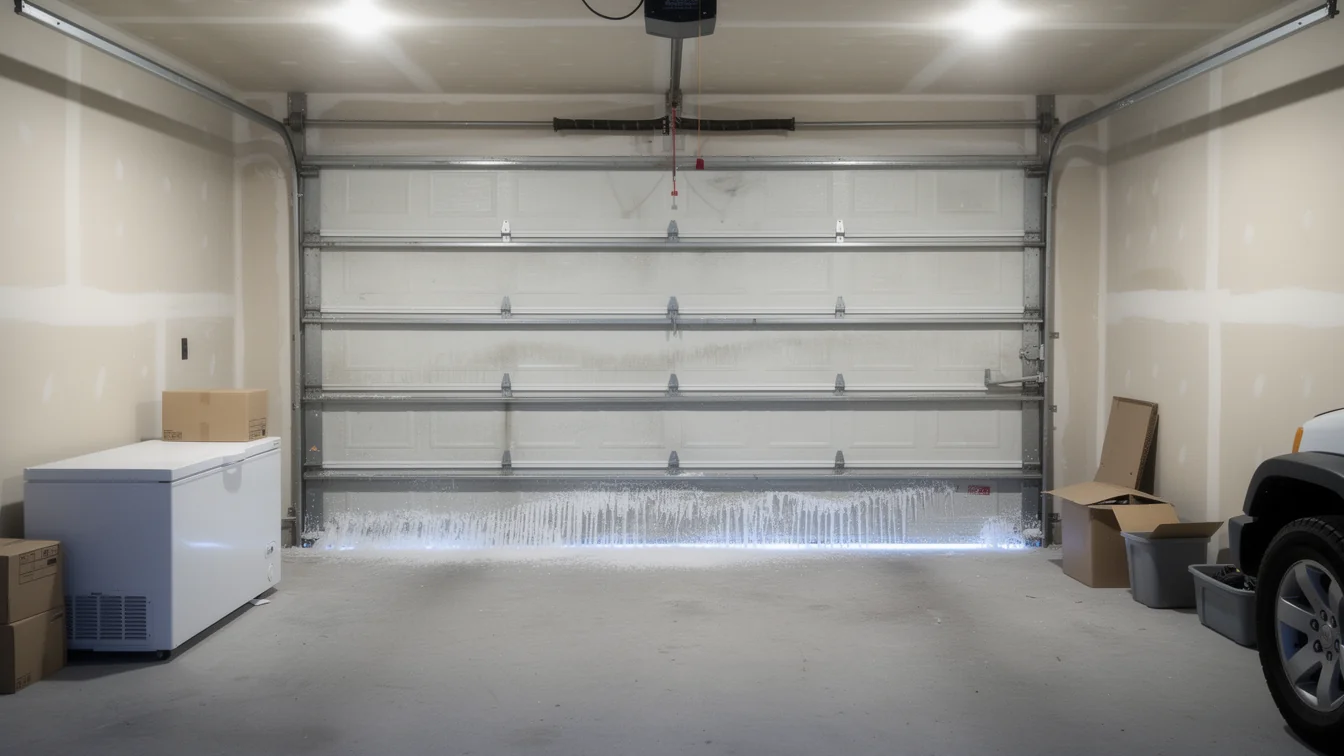
Another sign specific to older, uninsulated doors: condensation running down the inside of the panel in winter, sometimes pooling at the bottom track. That's the door acting as the only barrier between a heated or semi-heated garage and outdoor cold, with nothing in between to stop the temperature difference from condensing on the steel. Left alone, that moisture rusts the bottom panel and corrodes track hardware from the inside out. If you're seeing rust starting at the bottom two feet of an original-era door, that's worth a call now rather than next spring.
How Local Conditions Play In
This area sits in a climate band classed as severe cold, and a door built to no insulation standard at all feels that every winter. Steel contracts in cold, and on an uninsulated single-layer door that contraction is enough to change how the panel sits in the track - homeowners notice it as a door that tracks fine in July and catches or binds in January.
The torsion spring feels it too. Cold steel is stiffer and less forgiving, so a spring that's been quietly weakening for years on one of these older doors is more likely to let go on a frigid morning than a mild one - not because cold breaks springs, but because a marginal spring has less margin left when everything's contracted tight. On houses in this area built in that 1960s-70s window, we see more winter spring failures on original doors than on anything replaced in the last couple decades. It's one more reason the insulation retrofit conversation is worth having before the door that's served the house since 1968 finally gives out.
Frequently asked questions
Is my garage door too old to just add insulation to, instead of replacing it?
Depends on the panel condition, not just the age. If the steel isn't rusted through and the door still tracks straight, a retrofit insulation kit can work fine even on a door from the 1960s or 70s. If the panel's warped, rusted at the bottom, or the door is wood that's been swelling and shrinking for decades, replacement is usually the better call.
Why does my original door feel heavier in winter?
Uninsulated steel contracts in cold and can bind slightly in the track, and any moisture the panel's absorbed over the years adds dead weight. Combined with a spring that's already lost some tension, the door can feel noticeably harder to lift by hand on a cold morning than it does in summer.
Can you get parts for a door that old?
Often, yes, but not always fast. Doors built when this area was developed in the 1960s and 70s sometimes used panel sizes that aren't standard production today, so matching a single panel can mean a special order and a longer wait than a current door would need.
Related garage door services in Brunswick
More garage door guides
Book garage door service in Brunswick
Call now or request a quote - tell us what the door is doing and where you are.