
Brunswick, OH · Garage Door Service
Safety Sensors and Why They Drift in Brunswick Homes
Why garage door safety sensors drift out of alignment on Brunswick's older housing stock, what it costs to fix, and when the issue is more than a bent bracket.
- Repairs & new doors
- Springs & openers
- Serving 4 nearby communities
The Situation
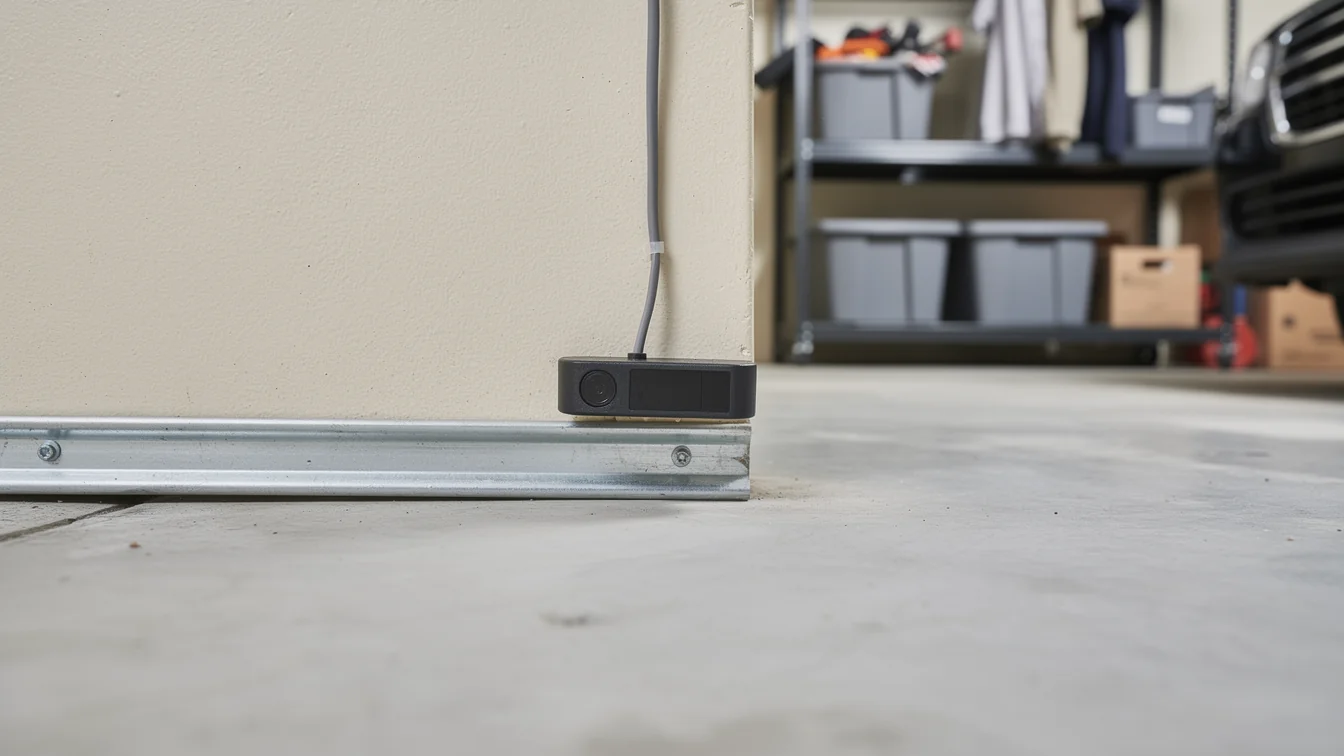
Walk into most Brunswick garages built before the 1980s and you'll find the safety sensors bolted onto whatever bracket got added when the opener was installed, not onto anything original to the door. Housing in this part of the county runs from 1938 up through 2002, with the typical build year sitting around 1968, so a big share of the garages we work in have steel jambs or old wood framing that was never squared for a modern photo-eye mount. That matters because the sensors only work if the two eyes stay pointed at each other within a fraction of an inch. On a jamb that's shifted over fifty-plus years, that alignment doesn't hold. We see the light blink out, the door refuse to close, and the owner assume the opener itself is bad when it's actually a bracket that's crept a quarter inch out of true. The drift isn't random - it tracks with how old the framing is and how many times someone's bumped a ladder or a bike against that bracket over the decades. Newer builds in town, closer to 2002, tend to hold alignment longer simply because the studs are straighter and the brackets were set with a level instead of eyeballed.
What It Costs
We don't have a flat number to hand you here, and we're not going to make one up. What drives the bill is whether the bracket just needs to be reset and tightened, or whether the wire running to it has cracked from age and needs to be replaced along with the bracket. A straightforward realignment on a bracket that's still sound is a short job. If the wiring insulation has gone brittle - which happens more on the older end of our housing stock, the houses nearer 1938 to 1960 than the newer end - you're paying for wire and labor, not just an adjustment. Income levels across this service area run a bit above the regional median, and most of the calls we get aren't people trying to save a few dollars by skipping the sensor fix - they just want the door to close reliably before the next cold snap. The honest answer is we can't quote you a number without looking at the bracket, the wire, and the door it's attached to.
When to Get Help
Call before the door gets stuck open or stuck shut on you. The usual tell is the opener light blinking a pattern instead of running the door - that's the opener telling you the sensors can't see each other. Try wiping both lenses first; dust and spiderwebs cause more false alarms than actual misalignment. If that doesn't fix it, look at whether one bracket has visibly rotated or if someone's recently leaned something against it - a bike, a trash can, a snowblower parked too close. If the bracket looks straight and the lenses are clean but the light still won't hold steady, that's a wiring or sensor-unit problem, not a quick fix you do yourself. Don't bypass the sensors to get the door working again. They're there because a door that closes on something - a kid, a pet, a car bumper - needs to stop. On the older houses in this area, where brackets were often added as an afterthought, a quick DIY bypass is the single worst move, because it's easy to forget to undo it.
How Local Conditions Play In
Brunswick sits in a climate band rated cold and severe, and that matters more for sensor brackets than people expect. Freeze-thaw cycles each winter heave and settle the slab and the surrounding soil, and a bracket mounted low on a jamb near that slab moves with it, even if nobody's touched it. A garage that measured perfectly aligned in October can be off by enough in January to trip the safety stop. This shows up across the wider area - Brunswick, North Royalton six miles off, Valley City the same distance, Medina eight miles out - wherever the housing stock leans 1960s and 70s construction with masonry or block foundations that were never designed to isolate a wood-frame door opening from ground movement. Newer construction with poured, code-compliant footers resists this better. If your sensors drift every winter and hold fine every summer, that's not a coincidence and it's not a sign the unit is failing - it's the ground moving under the bracket, and the fix is often a sturdier mount rather than a new sensor.
Frequently asked questions
Why do my garage door sensors only act up in winter?
In Brunswick's cold climate band, freeze-thaw cycles move the slab and soil around the garage opening every winter. If your sensor bracket is mounted near that slab, it shifts with the ground and throws the alignment off. Come spring, things often settle back close enough to work again, which is why it feels seasonal rather than broken.
Can I just unplug or bypass the safety sensors?
You can, but you shouldn't. Bypassing disables the stop-and-reverse function that keeps the door from closing on a person, pet, or object. On older Brunswick homes where brackets were often added after the original build, it's tempting to bypass rather than fix the mount, but it's the one shortcut we won't recommend.
Why is my sensor bracket loose when the house isn't that old?
Even houses toward the newer end of the 1938-2002 range in this area can have bracket issues if the mount was never leveled to begin with, or if something's bumped it. Age of the house matters less than whether the original installer squared the bracket to the jamb.
Does the type of foundation affect sensor alignment?
Yes. Block or masonry foundations common in the area's 1960s-70s housing stock move more with freeze-thaw cycles than newer poured, code-compliant footers. That ground movement transfers to the door jamb and the sensor bracket mounted on it, which is the main reason older homes see more drift.
Related garage door services in Brunswick
More garage door guides
Book garage door service in Brunswick
Call now or request a quote - tell us what the door is doing and where you are.